Introduction
The kitchen takes more punishment than any other room in the house — heat, moisture, heavy use, daily cleaning. Most materials handle that well for a few years, then show it. Stainless steel is built for the long run, which is why it's moved well beyond commercial kitchens into residential homes where owners want surfaces that last decades, not just a product cycle.
The upfront cost is real. Stainless steel cabinets and countertops typically run higher than wood, MDF, or laminate alternatives — but the calculus changes when you factor in what you won't be replacing, repainting, or repairing over 20 years.
This guide breaks down the practical case for stainless steel kitchens — durability, hygiene, design flexibility, and property value — so you can decide whether the investment makes sense for your home.
Key Takeaways
- Stainless steel kitchens resist water, heat, corrosion, and pests—offering a 50+ year lifespan versus 10-20 years for wood or laminate
- Non-porous surfaces prevent bacterial and mold growth, meeting the same hygiene standards as commercial foodservice environments
- Low maintenance requirements cut long-term repair and replacement costs over the life of the kitchen
- Timeless aesthetic works across design styles and can boost home resale value, with kitchen remodels recouping up to 113% of costs
- Higher upfront costs are offset by lifecycle value that wood and laminate alternatives can't match
What Is a Stainless Steel Kitchen?
A stainless steel kitchen consists of cabinet frames, doors, countertops, and sometimes shelving fabricated from steel alloyed with chromium—the element that gives stainless steel its signature corrosion-resistant properties. True stainless steel contains a minimum of 10.5% chromium, which forms an invisible chromium-oxide layer on the surface that prevents rust from spreading into the bulk metal.
Common Grades and Applications
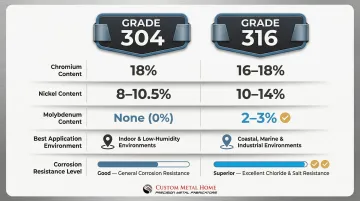
The two most common grades used in kitchen fabrication are:
| Feature | Grade 304 | Grade 316 |
|---|---|---|
| Chromium content | 18.0-20.0% | 16.0-18.0% |
| Nickel content | 8.0-10.5% | 10.0-14.0% |
| Molybdenum content | 0% | 2.0-3.0% |
| Best for | Standard residential kitchens, inland environments | Coastal environments, heavy chemical exposure |
| Corrosion resistance | Excellent general resistance | Superior chloride-pitting resistance |
Historically dominant in commercial and restaurant kitchens due to strict hygiene standards, stainless steel is increasingly common in modern residential settings—particularly in minimalist, industrial, and contemporary design styles. Homeowners are now specifying the same materials that restaurants have relied on for decades.
More Than a Surface: The Long-Term Case for Stainless Steel
Choosing stainless steel affects how a kitchen performs over decades: maintenance frequency, cleaning effort, structural integrity, and resale value all shift depending on the material behind the finish. While nearly three-quarters (74%) of homeowners already choose stainless steel for their kitchen appliances, that preference is now extending beyond appliances to the kitchen's built structure. Custom cabinetry, welded countertops, and integrated backsplashes are increasingly specified in stainless steel—moving the material from an appliance finish to a full architectural system.
Key Advantages of Stainless Steel Kitchens
The advantages below are grounded in practical, day-to-day outcomes rather than surface-level aesthetics. Each one connects to real costs, time, and long-term value that homeowners and property investors track.
Advantage 1: Exceptional Durability and Structural Longevity
Stainless steel is virtually impervious to the most common kitchen enemies—moisture, heat, humidity, and pests. Unlike wood which warps, MDF which swells, and laminate which peels, a properly fabricated stainless steel cabinet can last several decades without structural degradation.
Lifespan comparison across materials:
- Laminate/Thermofoil: 10-20 years (delamination, peeling near heat sources)
- MDF/Particleboard: 15-20 years (water damage, swelling, crumbling)
- Plywood: 25-30 years (prolonged moisture exposure)
- Solid Wood: 30-50+ years (warping, termite infestation, high maintenance)
- Stainless Steel: 50+ years (lifetime)
Long-Term Cost Comparison
This longevity eliminates the cycle of premature cabinet replacement that plagues wood and MDF kitchens. Over a 20-30 year period, a higher upfront investment in stainless steel often offsets two or more full replacement cycles of cheaper alternatives.
Consider the Total Cost of Ownership (TCO) over 30 years:
- Stainless steel scenario: $36,000 upfront + $50/year maintenance + $800 professional polishing at year 15 = $39,100 total
- Wood/MDF scenario: $11,200 upfront + $150/year maintenance + $6,000 major repair/refacing at year 15 = $27,700 total
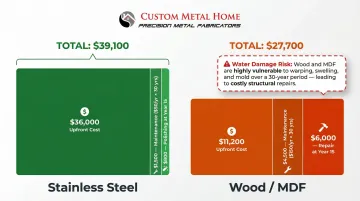
The wood/MDF figure looks lower on paper, but it assumes no catastrophic water damage—a scenario that affects approximately 1 in 60 insured homes annually. One flood event can erase that entire cost advantage.
KPIs impacted: Replacement frequency, maintenance spend over 10-20 years, structural integrity rating, resistance to warping/swelling in high-humidity environments.
When this advantage matters most: Homes in coastal, humid, or high-rainfall climates where moisture damage accelerates deterioration; high-traffic family kitchens with heavy daily use; anyone planning to stay in their home long-term.
Advantage 2: Superior Hygiene and Low-Maintenance Upkeep
Stainless steel is a non-porous material, meaning liquids, grease, and food particles cannot seep into the surface. This prevents bacterial and mold growth at the material level, not just at the cleaning level. It's why food-service regulations globally mandate stainless steel in professional kitchens.
The Science of Hygiene
The FDA Food Code mandates that multiuse food-contact surfaces must be safe, durable, corrosion-resistant, nonabsorbent, and finished to have a smooth, easily cleanable surface. Stainless steel inherently satisfies these rigorous regulatory demands.
Pathogens behave very differently on porous versus non-porous surfaces. Studies on Klebsiella pneumoniae demonstrated a rapid 4-log decrease in viable bacteria within just one day on non-porous surfaces, while porous materials like wood can trap bacteria in their grain structure, making complete sanitization difficult.
Wood composites like MDF and particleboard are particularly vulnerable to mold and fungal growth in high-humidity environments. Particleboard's porous structure retains moisture and provides the organic material that fungal species like Aspergillus and Trichoderma need to thrive.
The Maintenance Reality
Stainless steel surfaces require only mild soap and water or a microfiber cloth for routine cleaning. Wood, by contrast, demands more:
- Grout lines, sealed wood grains, and laminate seams trap bacteria over time
- Specialized cleaning products are often needed for deep-cleaning
- Periodic resealing or refinishing adds cost and effort
The practical trade-off: brushed stainless finishes largely eliminate fingerprint visibility, and routine upkeep stays far less intensive than maintaining wood cabinets.
KPIs impacted: Cleaning time per week, product spend on maintenance, bacterial contamination risk, frequency of deep-cleaning interventions.
When this advantage matters most: Households with young children or elderly members where hygiene is a priority; anyone managing allergies and mold sensitivities; small kitchens with limited ventilation where moisture and grease accumulate faster.
Advantage 3: Design Versatility and Long-Term Property Value
Modern stainless steel kitchens have shed the purely industrial look. Available in brushed, matte, mirrored, and color-coated finishes, they integrate effectively into contemporary, minimalist, and even hybrid kitchen designs that combine steel with wood or stone accents. Custom fabrication allows configurations for any kitchen layout or size.
Design Longevity
Unlike trendy painted finishes or wood tones that date quickly, stainless steel's neutral metallic palette holds up aesthetically across design cycles. The National Kitchen & Bath Association reports that kitchen designs typically become outdated after 15 years, with cabinets being the first features to show their age. Stainless steel's timeless aesthetic means the kitchen won't look dated in 10 years the way a wood-heavy design might.
Impact on Resale Value
Kitchen quality is a primary driver of home resale value. According to the 2025 Remodeling Cost vs. Value Report, a minor midrange kitchen remodel yields a 113% return on investment (cost recouped at resale). Buyers increasingly associate stainless steel kitchens with premium hygiene standards and durable construction.
Custom-fabricated stainless steel kitchens allow homeowners to tailor every dimension, finish, and configuration—maximizing both function and aesthetic fit with the rest of the home. That flexibility is especially valuable in non-standard layouts where off-the-shelf cabinetry falls short.
KPIs impacted: Home resale price, time on market, buyer perception of kitchen quality, design longevity (years before the kitchen feels visually outdated).
When this advantage matters most: Homeowners planning to sell within 5-15 years; real estate investors renovating for rental or resale; anyone in a competitive housing market where kitchen quality directly influences buyer decisions.
What Happens When Durability Is an Afterthought in Kitchen Design
Choosing low-durability materials creates a compounding cost pattern: initial savings on cheaper materials are typically erased within 5-10 years by repair costs, partial replacements, and refinishing work—steam, grease, and daily wear accelerate every failure mode.
Common Failure Modes in Non-Stainless Alternatives
MDF and particleboard cabinets are the most vulnerable. When a leaky sink or dishwasher soaks these compressed-wood materials, they swell permanently and lose the ability to hold screws or support weight. Water damage insurance claims average $13,954—and unlike solid materials, MDF cannot be dried and reused.
The insurance fallout often compounds the damage. When a single base cabinet is destroyed by water, adjusters frequently require the entire cabinet run to be replaced for uniform appearance—particularly if the original style is discontinued. A minor repair becomes a $12,000 to $30,000 full cabinet replacement.
Other common failures include:
- Mold growth in laminate seams
- Insect damage to wood substrates
- Peeling finishes from heat exposure near stoves
- Structural weakening from water damage under sinks
- Countertop collateral damage (10-30% risk of stone cracking during cabinet removal)
These physical failures don't just cost money to fix—they cost money at resale. Buyers and appraisers discount homes with visibly worn cabinetry, turning upfront savings into a liability when it matters most.
How to Get the Most Value from Your Stainless Steel Kitchen
Match Steel Grade to Environment
Stainless steel kitchens deliver peak value when the grade of steel is matched to the environment. Grade 304 works well for most residential kitchens, while Grade 316 (with higher molybdenum content) is recommended for coastal homes or commercial settings with heavy chemical exposure.
The coastal specification rule:
Within one mile of the coastline, airborne marine aerosols cause rapid chloride-induced pitting and "tea staining" on Grade 304. The 2-3% molybdenum in Grade 316 raises the Pitting Resistance Equivalent Number (PREN) from ~18 to ~24 — enough to resist salt-air corrosion where Grade 304 cannot.
In a coastal zone, using Grade 304 leads to rapid aesthetic and structural degradation. The upgrade to 316 is not optional; it's the baseline specification.
Leverage Customization
Working with a custom metal fabrication specialist allows homeowners to specify cabinet dimensions, drawer configurations, finish type, and integrated features that fit their exact kitchen layout rather than working around a standard modular layout.
Maintain the Investment Properly
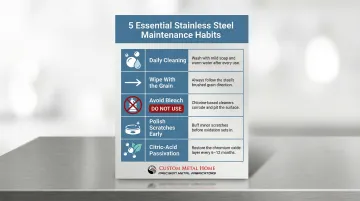
Critical maintenance habits:
- Clean daily with mild soap and warm water — no abrasive pads or scouring powders
- Wipe in the direction of the brushed grain to preserve the finish
- Avoid chlorine bleach entirely — it strips the protective chromium-oxide layer, leading to contact rust and pitting
- Address scratches with steel polish before oxidation takes hold
- For deeper cleaning, citric-acid-based passivation safely removes free iron without hazardous chemicals
Light scratches are inevitable with daily use. Over time they blend together into a natural patina that most owners come to prefer over a factory-perfect surface.
On the design side, stainless pairs well with warm wood tones, natural stone countertops, or a bold tile backsplash — all of which soften the industrial edge without compromising the material's character.
Conclusion
Stainless steel kitchens cost more upfront, but they deliver compounding returns: reduced maintenance, eliminated replacement cycles, superior hygiene, and sustained property value.
The lifecycle cost is lower than it first appears once you factor in the 50+ year lifespan and the avoided costs of water damage, mold remediation, and premature replacement.
The value is not just financial. The durability and hygiene advantages translate directly into a cleaner, lower-stress daily kitchen experience that compounds over years of use. For homeowners in coastal or high-humidity environments, families prioritizing health and hygiene, or anyone planning to stay in their home long-term, the investment case is particularly strong.
The right stainless steel kitchen, chosen and maintained correctly, earns its cost back — and keeps earning it for decades.
Frequently Asked Questions
How long do stainless steel kitchen cabinets typically last?
With proper care, stainless steel cabinets last 50+ years without structural degradation — far beyond wood or laminate alternatives, which typically need replacement or refinishing within 10-20 years. Many manufacturers back this with lifetime warranties for residential use.
Are stainless steel kitchens hard to maintain?
Day-to-day maintenance is straightforward—mild soap and a microfiber cloth handle most cleaning needs. Brushed finishes reduce visible fingerprinting, and the surface never needs sealing, staining, or repainting like wood alternatives.
Do stainless steel kitchens increase home resale value?
A well-designed stainless steel kitchen signals quality, durability, and hygiene to buyers and can positively influence resale pricing. Kitchen remodels currently recoup up to 113% of costs at resale, particularly in competitive markets where kitchen condition is a key purchase driver.
What grade of stainless steel is best for kitchen cabinets?
Grade 304 suits most residential kitchens. Grade 316 is the better choice for coastal climates or heavy-use commercial settings, where its higher corrosion resistance prevents the pitting that chloride exposure can cause.
Is $30,000 enough for a kitchen remodel?
$30,000 is a workable budget for a mid-range kitchen remodel, though a full stainless steel kitchen (custom cabinetry, countertops, installation, and labor) typically ranges from $25,000 to $38,000. Costs vary based on kitchen size, grade of steel, customization level, and local labor rates.
Are stainless steel kitchens a good choice for residential homes?
Stainless steel kitchens are increasingly popular in residential settings, especially in modern and minimalist designs. They suit homeowners who prioritize durability, hygiene, and long-term value over the warmer, traditional look of wood—and are particularly well-suited to coastal environments and high-moisture climates.