Introduction
Restaurant kitchens run on organization—shelving is the backbone of every efficient prep line, dry storage room, and walk-in cooler. Yet it's one of the most under-researched purchases operators make. The consequences show up fast: shelves that bow under bulk ingredients, units that rust out at dishwashing stations, and health inspection citations for corroded wire racks.
Those failures trace back to one root cause: the wrong shelving material for the environment. Grade, gauge, NSF certification, and load capacity directly affect whether a shelf lasts one season or a decade. Chrome wire corrodes rapidly in high-moisture zones, with replacement costs that far exceed the upfront savings. Epoxy-coated wire peels and traps buildup — a direct path to unsanitary conditions.
Health inspectors regularly cite violations including:
- "Rusty shelves in food prep area"
- "Black, flaking residue on shelving units"
- "Corroded wire racks in contact with food storage"
This guide covers what actually separates durable commercial shelving from shelf-shaped liabilities — then puts the best options side by side so you can buy once and move on.
Key Takeaways
- Stainless steel is the industry standard due to its non-porous surface, corrosion resistance, and ease of sanitation
- 304 SS is best for wet zones; 430 SS suits dry storage; 16–18 gauge is the commercial minimum
- NSF certification is non-negotiable—it signals health code compliance and simplifies inspections
- Match weight capacity to actual load: light-duty, medium-duty, or heavy-duty based on what you're storing
- Top picks include Metro, Advance Tabco, John Boos, Regency, and custom-fabricated units for non-standard spaces
Why Stainless Steel Is the Industry Standard for Restaurant Kitchen Shelving
In commercial kitchens, material choice directly affects sanitation scores, equipment longevity, and day-to-day operations. High-moisture, high-traffic environments where surface contamination can trigger health violations demand materials built to handle the pressure.
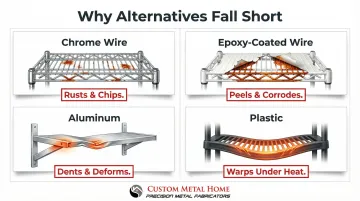
Core advantages over alternatives:
- Chrome wire: Chips and rusts quickly in wet zones
- Epoxy-coated wire: Coating degrades, exposing metal to corrosion
- Aluminum: Softer metal that dents more easily under heavy loads
- Plastic: Warps near heat sources and lacks structural integrity
Stainless steel checks every box: corrosion resistance, non-porous surfaces that are easy to sanitize, and structural durability under heavy loads. The FDA Food Code requires that non-food-contact surfaces exposed to splash or spillage be corrosion-resistant, nonabsorbent, and smooth — stainless steel meets all three criteria out of the box, which is why it remains the go-to choice across commercial kitchens.
The section below breaks down the exact specifications and features to evaluate before purchasing, followed by a curated list of top-performing shelving options.
What to Look for When Buying Stainless Steel Shelving for a Restaurant Kitchen
Stainless Steel Grades: Match the Grade to the Kitchen Zone
304 SS (18-20% chromium, 8-10% nickel): This is the standard for wet zones—food prep areas, dishwashing stations, and anything near sinks. The addition of nickel provides excellent resistance to corrosion. If shelves will be in a high-moisture area like a dishwashing station or walk-in cooler, 304-grade is required for superior rust prevention.
430 SS (16-18% chromium, minimal nickel): Because it lacks nickel, it has lower corrosion resistance than the 300 series. For most dry storage applications, 430 stainless steel is a cost-effective choice, but it should not be used in wet zones.
201 SS (chromium-nickel-manganese alloy): This grade has higher tensile strength than 304, which may allow for thinner gauges, but due to lower chromium and nickel content, it offers lower corrosion resistance. Acceptable only for low-moisture, light-duty areas with higher long-term corrosion risk.
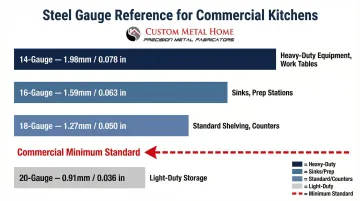
Steel Gauge: Lower Numbers Mean Thicker, Stronger Steel
Gauge works in reverse: lower numbers mean thicker steel. For commercial kitchens, 16-gauge or 18-gauge is the accepted minimum. Thinner gauges (20+) are prone to bending under heavy loads and are not suitable for primary kitchen storage.
Commercial kitchen gauge reference:
| Gauge | Thickness | Typical Application |
|---|---|---|
| 14-gauge | 1.98 mm (0.0781") | Heavy-duty equipment stands, structures, frames |
| 16-gauge | 1.59 mm (0.0625") | Premium commercial sinks, prep tables, light-duty cabinets |
| 18-gauge | 1.27 mm (0.0500") | Lightweight kitchen equipment, dry storage shelving |
| 20-gauge | 0.95 mm (0.0375") | Wall cladding, consumer appliances, non-load-bearing panels |
NSF Certification: Non-Negotiable for Health Code Compliance
The National Sanitation Foundation certifies shelving that meets strict public health standards for non-porous surfaces, ease of sanitization, and corrosion resistance. NSF-certified shelves are often required by local health departments for food-contact and food-adjacent surfaces.
The FDA Food Code (Section 4-205.10) explicitly states that food equipment certified by an ANSI-accredited certification program is deemed to comply with design and construction requirements. Local health departments enforce this strictly. Los Angeles County, for example, requires all new and replacement food-related equipment to carry certification from an ANSI-accredited program.
Non-NSF shelving found during a health inspection can trigger a failed score, mandatory replacement, or temporary closure — costs that far exceed the price difference of certified shelving.
Weight Capacity: Avoid Overloading and Structural Failure
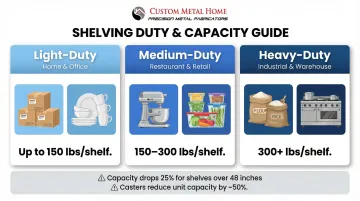
Shelves are rated per shelf and per unit. Operators should categorize their storage needs:
- Light-duty: Dry goods, dishware (up to ~150 lbs/shelf)
- Medium-duty: Countertop appliances, containers (~150–300 lbs/shelf)
- Heavy-duty: Bulk ingredients, large equipment (300+ lbs/shelf)
Capacity drops significantly with shelf length. Standard wire shelves hold 800 lbs up to 48 inches, but capacity drops by 25% (to 600 lbs) for shelves 54 inches or longer to prevent bowing. Adding casters drastically reduces total unit capacity — a stationary unit rated for 2,000 lbs is typically reduced to 1,000 lbs when made mobile.
Always cross-reference the manufacturer's load rating against your heaviest anticipated shelf load before purchasing — not after installation.
Shelf Types and Ideal Use Cases
Once you've confirmed capacity requirements, the shelf configuration determines how well the unit fits your space and workflow:
- Wall-mounted shelves: Maximize vertical space above prep stations; ideal for tight kitchens where floor space is limited
- Freestanding units: Offer flexibility and high load capacity for storage rooms, walk-ins, and areas that need to be repositioned
- Adjustable shelves: Accommodate variable inventory heights; allow reconfiguration as menu or stock changes
- Under-counter shelves: Use dead space beneath prep tables for pots, pans, mixing bowls, and small equipment
Top Stainless Steel Shelving Picks for Restaurant Kitchens
Selections are based on construction quality, NSF certification status, load capacity, material grade, and real-world suitability across different kitchen zones and operation sizes.
Metro
Metro (InterMetro Industries) is one of the most recognized names in commercial shelving globally, originally known for wire shelving and now offering a full stainless steel line widely specified in professional kitchens, hospitals, and food production facilities.
Key differentiators:
- NSF certified across the commercial stainless line
- Available in wall-mount, freestanding, and mobile configurations
- Tool-free post-and-shelf assembly for fast setup and reconfiguration
- Polymer or stainless finish options for wet and dry kitchen zones
| Specification | Details |
|---|---|
| Material Grade | 304 stainless steel (food-zone units) |
| Weight Capacity | 800 lbs per shelf (up to 48" length); 2,000 lbs per unit (stationary) |
| Best For | High-volume kitchens needing modular, reconfigurable storage across multiple zones |
Advance Tabco
Advance Tabco is a U.S.-based manufacturer specializing in stainless steel foodservice equipment, with a long-standing focus on solid-surface shelving, sinks, and prep tables built to commercial kitchen specifications.
Key differentiators:
- Solid stainless steel sheet construction (not wire) — flat surface prevents container tipping
- NSF certified across the commercial line
- 18-gauge 430 SS standard for dry zones; 304 SS available for wet-area use
- Rolled edges reduce injury risk and simplify cleaning
| Specification | Details |
|---|---|
| Material Grade | 430 SS standard; 304 SS available |
| Construction Style | Solid flat-surface shelf with rolled edges; wall-bracket or freestanding configurations |
| Best For | Kitchens prioritizing easy-clean solid surfaces over open-wire ventilation designs |
John Boos
John Boos & Co. is a century-old American manufacturer known for premium foodservice surfaces. Their stainless steel shelving and work table combinations are a fixture in high-end restaurant kitchens and culinary schools.
Key differentiators:
- 304 stainless steel standard across the entire shelving line (not just select SKUs)
- Multiple gauge options (18, 16, or 14-gauge) matched to load requirements
- NSF/ANSI certified; suited for open-concept kitchens where aesthetics matter
- Heavy-gauge units function as both storage shelves and equipment stands
| Specification | Details |
|---|---|
| Material Grade | 304 stainless steel standard across commercial shelving line |
| Gauge Options | 18-gauge, 16-gauge, or 14-gauge steel depending on load requirement |
| Best For | High-end or open-concept restaurant kitchens needing premium-grade, aesthetic, heavy-duty storage |
Regency Shelving
Regency is a mid-market commercial shelving brand widely stocked by restaurant supply distributors in the U.S., offering a broad range of stainless steel wall-mount, freestanding, and under-shelf units at accessible price points.
Key differentiators:
- NSF-certified commercial-grade shelving at mid-market price points
- Knock-down shipping with tool-free or minimal-tool assembly
- Adjustable shelf heights compatible with standard commercial post diameters
- Broad SKU availability through major U.S. restaurant supply distributors
| Specification | Details |
|---|---|
| Price Range | $130–$890 depending on size and configuration |
| Assembly | Knock-down, tool-free or minimal-tool assembly; compatible with standard commercial shelving accessories |
| Best For | Smaller restaurants, ghost kitchens, or operators outfitting on a budget without sacrificing NSF compliance |
Custom Fabricated Stainless Steel Shelving
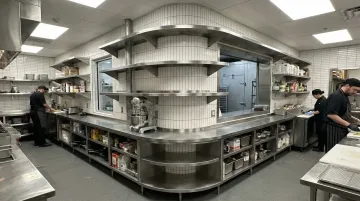
Off-the-shelf products often leave wasted space or create workflow problems in kitchens with non-standard wall dimensions, unusual ceiling heights, awkward corner layouts, or specialized storage requirements. Custom metal fabrication solves this with shelving built to exact specification.
Key differentiators:
- Full specification control: dimensions, depth, gauge, grade (304 or 430), edge treatment, and mounting style
- Eliminates the compromise of forcing standard units into non-standard spaces
- Particularly effective for walk-in cooler builds, narrow galley kitchens, and renovation projects
- No wasted space; shelving fits the kitchen, not the other way around
Operators looking for custom stainless steel shelving solutions can reach the team at +1 888-501-3147.
| Specification | Details |
|---|---|
| Customization Scope | Exact dimensions, grade selection (304/430), gauge, edge finish, mounting configuration—to operator specification |
| Lead Time | Varies by fabricator; typically 1–4 weeks depending on complexity |
| Best For | Kitchens with unique spatial constraints, high-spec hygiene requirements, or where standard products consistently leave workflow or space gaps |
How We Selected the Best Stainless Steel Shelving for Restaurant Kitchens
Every pick on this list was evaluated against the standards that actually matter in a working kitchen — not just price or looks. We focused on six core criteria:
- Material grade suited to commercial kitchen conditions (304 vs. 430 stainless)
- Gauge and thickness for structural integrity under heavy load
- NSF certification for health code compliance
- Weight capacity ratings tested against real-world kitchen demands
- Configuration options (adjustable, wall-mounted, freestanding)
- Brand reliability in professional foodservice settings
Common mistakes operators make when purchasing kitchen shelving:
- Choosing by price alone: Getting undersized gauge that bows under load, requiring premature replacement
- Placing 430 SS shelves in wet zones — moisture causes surface rust and puts you at risk of health code violations
- Skipping NSF certification: Risking non-compliance during health inspections and potential citations
- Ignoring weight ratings until a shelf fails — which means safety hazards, product loss, and an emergency replacement on a busy service day
- Buying fixed-size units that don't fit the space: Resulting in wasted square footage and inefficient workflow
Conclusion
Choosing the right stainless steel shelving comes down to four things:
- Matching material grade (304 vs. 430) to the kitchen zone
- Verifying NSF certification for food-contact surfaces
- Selecting load capacity appropriate to what's actually stored
- Picking a shelf configuration that supports real workflow, not a generic layout
Get those four right, and the brand on the label matters far less than operators often assume.
For kitchens with non-standard layouts or specific load requirements, custom-fabricated stainless steel shelving offers precision that off-the-shelf products cannot match. To discuss a custom build, contact the team directly at +1 888-501-3147.
Frequently Asked Questions
What stainless steel grade and gauge are best for restaurant kitchen shelving?
304 SS is recommended for wet zones (near sinks, dishwashers, prep tables) due to its high chromium-nickel content and corrosion resistance, while 430 SS suits dry storage areas. For gauge, 16- or 18-gauge is the commercial standard—lower numbers mean thicker, stronger steel.
Is stainless steel good for restaurant kitchen shelves and racks?
Yes, stainless steel is the preferred material for commercial kitchen shelving because its non-porous surface resists bacterial growth, its chromium content prevents rust and corrosion, and it withstands the moisture, heat, and chemical cleaning agents present in a professional kitchen environment.
What is NSF certification and why does it matter for kitchen shelves?
NSF certification means the shelf has been independently tested to meet public health standards for food-contact surfaces — non-porous, easy to sanitize, and corrosion-resistant. Most local health departments require NSF-certified shelving during inspections.
How do I determine the right weight capacity for my restaurant shelves?
Start by listing the heaviest items you'll store per shelf, then choose a rated capacity that safely exceeds that load. Light-duty works for dry goods and dishware, medium-duty handles countertop appliances, and heavy-duty covers bulk ingredients, large cookware, and walk-in cooler storage.
Can stainless steel shelves be used inside walk-in coolers and freezers?
Commercial-grade 304 SS handles walk-in coolers and freezers well — it resists low temperatures, humidity, and the condensation common in refrigerated environments. Choose NSF-certified units for these areas.
How should stainless steel kitchen shelves be cleaned and maintained?
Wipe shelves daily with warm water and a mild food-safe detergent, and use a commercial degreaser for stubborn grease. Avoid chlorine-based cleaners and abrasive materials like steel wool. Both can cause pitting and accelerate corrosion, particularly on 430 and 201 grade steel.