Introduction
Choosing a stainless steel countertop is more complex than most homeowners and commercial kitchen operators expect. Grades, gauges, finishes, and fabrication options multiply fast — and each decision affects how the surface performs over time.
Pick the wrong gauge and it dents under daily prep work. Choose the wrong grade and it corrodes near a sink within a few years. Get the finish right, and the same countertop can last 20 years with minimal upkeep.
This guide walks through every major buying factor—from steel grade and gauge to edge profiles, finishes, integrated features, and budgeting—so you know exactly what to ask before you buy.
Key Takeaways
- Stainless steel countertops are nonporous, heat-resistant, and exceptionally durable for both residential and commercial kitchens
- Grade 304 is the standard; 316L offers greater corrosion resistance for coastal or chemical environments
- Choose 16-gauge for home kitchens and 14-gauge for commercial settings; skip 18-gauge
- Brushed finishes conceal fingerprints and scratches better than polished surfaces
- Custom fabrication choices like integrated sinks, backsplashes, and edge profiles affect both functionality and final cost
What Are Stainless Steel Countertops?
Stainless steel is a corrosion-resistant steel alloy containing at least 10.5% chromium. In countertop applications, the steel sheet is bonded to a rigid substrate—typically plywood or MDF—to prevent flexing and eliminate the hollow "drumming" sound of unsupported sheet metal.
Three grades dominate kitchen applications:
- 304 – High chromium and nickel content; best for most kitchens
- 316L – Adds molybdenum for superior resistance to salt, acids, and harsh chemicals
- 430 – Lower nickel content and weaker corrosion resistance; worth knowing because it appears in the market, but avoid it for countertop use
Most countertops are fabricated in 14- or 16-gauge steel with a brushed or matte surface. Type 304 with a No. 4 brushed finish is the industry standard starting point. Both gauge and finish have a direct impact on durability and maintenance—two factors this guide covers in detail.
Key Factors to Look for When Buying a Stainless Steel Countertop
Grade, gauge, finish, edge profile, and integrated features all interact — and each decision affects how the countertop performs over years of use. Here's what each specification means and how to choose based on your kitchen's actual demands.
Steel Grade
304 (18% chromium, 8% nickel): The baseline for most residential and commercial kitchens. Offers excellent corrosion resistance, is non-magnetic, and handles daily moisture and cleaning without issue.
316L (16-18% chromium, 10-14% nickel, 2-3% molybdenum): Adds molybdenum for superior resistance to chlorides, acids, and harsh chemicals. Recommended for coastal environments where salt exposure is high, or in food processing facilities where caustic cleaning agents are used regularly.
430 (16-18% chromium, minimal nickel): A ferritic steel that is magnetic and highly vulnerable to corrosion from acids and chlorides. Suitable only for decorative trim or appliance doors—never for countertop surfaces.
Recommendation: Choose 304 as your baseline. Only step up to 316L if your kitchen involves heavy chemical exposure, coastal salt, or food processing environments.
Gauge and Thickness
Gauge numbers operate on an inverse scale: lower numbers mean thicker, stronger steel.
| Gauge | Thickness (inches) | Application |
|---|---|---|
| 14-gauge | 0.0747"–0.0781" | Heavy-duty commercial kitchens |
| 16-gauge | 0.0598"–0.0625" | Standard residential countertops |
| 18-gauge | 0.0478"–0.0500" | Light-duty panels; prone to denting |
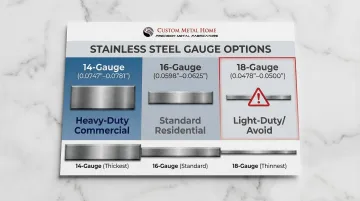
Why thickness matters: Thicker steel resists denting, warping, and the hollow "drumming" sound under impact. 18-gauge is too thin for countertop surfaces and will flex under normal use.
Recommendation: Use 16-gauge for residential kitchens (balances durability and cost) and 14-gauge for commercial or heavy-use environments.
Important note: The Specialty Steel Industry of North America warns that gauge thicknesses vary by producer. Always specify exact decimal thickness in your order to ensure structural requirements are met.
Surface Finish
Surface finish affects both aesthetics and how well the countertop hides daily wear.
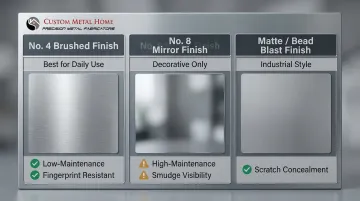
No. 4 Brushed (120-150 grit):
- Directional linear grain with a soft satin sheen
- Diffuses light to hide fingerprints, water spots, and minor scratches
- Easiest to maintain in high-traffic kitchens
- Complements stainless steel appliances
No. 8 Mirror (polished):
- Highly reflective, mirror-like surface
- Shows every fingerprint, smudge, and micro-scratch
- Requires constant cleaning
- Best reserved for low-touch decorative accents
Matte / Bead Blast:
- Non-directional, uniform, low-reflectivity
- Hides scratches well but skin oils can cloud the surface
- Subdued appearance suits transitional or industrial styles
Default to No. 4 brushed for most kitchens. Polished finishes look dramatic but demand constant maintenance.
Edge Profile
Edge profiles balance aesthetics, spill containment, and safety.
Square Edge:
- Clean, flat, modern appearance
- Most popular residential choice
- No drip protection—liquids can run off onto cabinets
Marine Edge:
- Raised flat-topped lip around the perimeter
- Contains spills and prevents liquid run-off
- Essential for bars and commercial prep areas
Raised V-Edge:
- Angled edge that redirects drips away from cabinets
- More pronounced than marine edge
- Some chefs find it slightly intrusive as a working edge
Bullnose:
- Rounded, continuous profile (typically 1-1/2" diameter)
- Eliminates sharp corners
- Ideal for commercial kitchens or homes with children
Select based on your primary concern: aesthetics (square or bullnose), spill containment (marine or raised V), or safety (bullnose).
Integrated Features
Integrated features are welded directly into the countertop during fabrication, creating a seamless, watertight surface with no joints or crevices where bacteria or moisture can collect.
Common integrated features:
- Single, double, or triple bowl sinks
- Drainboards
- Backsplashes
- Side splashes
Why integration matters: NSF/ANSI 2 standards require smooth, crevice-free food zones for commercial applications. Drop-in sinks and caulked seams create bacterial contamination risks and violate health codes.
Critical planning note: Integrated features must be specified and fabricated together from the start — retrofitting is not possible. Work with your fabricator before finalizing any countertop dimensions or cabinet layout.
Budget and Customization Scope
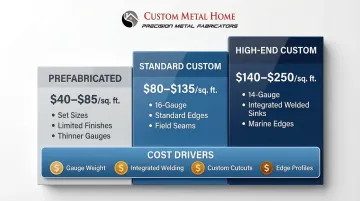
Current installed costs (2024-2026):
| Build Type | Cost per Sq. Ft. | Features |
|---|---|---|
| Prefabricated | $40–$85 | Set sizes, limited finishes, thinner gauges |
| Standard Custom | $80–$135 | 16-gauge, standard edges, field seams |
| High-End Custom | $140–$250 | 14-gauge, integrated welded sinks, marine edges |
Cost drivers:
- Material gauge: 14-gauge costs more than 16-gauge due to weight
- Integrated welding: Factory-welded sinks add $500–$1,500 per unit
- Custom cutouts: Faucets, outlets, and specialty openings increase labor
- Edge profiles: Complex edges cost more than standard square
Recommendation: Weigh total cost of ownership. A 14-gauge countertop with an integrated sink costs more upfront but eliminates future replacement costs and reduces maintenance.
Pros and Cons of Stainless Steel Countertops
Stainless steel countertops hold up well in demanding environments, but they come with real trade-offs worth knowing before you buy.
Advantages
- Requires no sealing and resists bacteria growth naturally — a key reason commercial kitchens rely on it
- Handles direct heat from pots and pans without warping, scorching, or discoloration
- Won't absorb liquids or food pigments, so stains wipe away cleanly
- Lasts 20+ years with basic maintenance
- Highly sustainable: 95% of end-of-life stainless is recycled, and 300-series grades produced in North America contain 75–85% recycled content
Drawbacks
- Visible surface scratches, particularly on polished finishes — they accumulate with daily use
- Fingerprints and water spots show up easily; polished surfaces are the worst offenders
- Thin-gauge steel without a solid substrate produces a hollow, "tinny" sound under impact
Mitigation: Choose brushed or matte finishes to hide scratches and fingerprints. Use 16-gauge or thicker steel bonded to a quality substrate to eliminate hollow sound.
How a Custom Metal Fabricator Can Help
Off-the-shelf stainless steel countertops are rarely cut to exact kitchen dimensions and cannot accommodate integrated sinks or custom edge profiles. A custom metal fabricator works from precise measurements to produce a countertop that fits your exact layout, with the grade, gauge, finish, and integrated features you select.
A qualified fabricator typically handles:
- Material selection guidance (grade, gauge, finish)
- Custom sizing based on on-site measurements
- Welding integrated features (sinks, drainboards, backsplashes)
- Applying specified finishes
- Delivering a finished piece ready for installation
Not all fabricators offer the same level of skill or transparency. When evaluating options, look for:
- Demonstrated experience with both residential and commercial projects
- Ability to work in multiple grades and gauges
- A clear quoting process that accounts for all customization variables upfront
- Clean, consistent welds ground and polished to blend with the surrounding surface
The right fabricator eliminates guesswork — you confirm every specification before production begins, so the finished piece fits the first time.
Conclusion
The right stainless steel countertop comes down to fit: the right gauge, finish, edge profile, and fabrication method for how your kitchen actually works.
Treat this purchase as a long-term investment rather than a commodity buy. Work with an experienced fabricator who can translate your specific kitchen requirements into a custom-fabricated surface built to those exact requirements — one that performs reliably for decades without compromising on appearance or function.
Frequently Asked Questions
What gauge stainless steel is best for countertops?
16-gauge is the recommended standard for residential kitchens, strong enough for daily use without the premium price of 14-gauge. 14-gauge is preferred for commercial or heavy-use environments. 18-gauge is generally too thin for countertop applications and prone to denting.
How to know if stainless steel is high quality?
Look for grade 304 or 316L steel, 14- or 16-gauge thickness, and a non-magnetic response — a magnet that sticks signals lower-grade 400-series steel. Clean, consistent welds and a uniform finish indicate quality fabrication.
Are stainless steel countertops good for home kitchens or just commercial use?
Stainless steel works well in residential kitchens — it's hygienic, heat-resistant, and low-maintenance. Home installations typically use 16-gauge steel with a brushed or matte finish, while commercial kitchens lean toward heavier 14-gauge.
Do stainless steel countertops scratch easily?
Stainless steel is susceptible to surface scratches, particularly on polished finishes, but a brushed or matte finish makes scratches far less visible. Minor surface scratches can often be buffed out. Always use a cutting board — cutting directly on stainless steel will permanently score the surface.
What is the average cost of a stainless steel countertop?
Installed costs range from $70 to $225 per square foot in 2024-2026, depending on gauge, grade, finish, edge profile, and integrated features. Custom fabrication costs more upfront but delivers a longer-lasting, precisely fitted result.