Introduction
Outdoor kitchens have surged in popularity, with 35% of premium grill owners now featuring full outdoor kitchens at an average investment of $10,600. When you're spending that kind of money, the countertop material becomes a make-or-break decision for longevity and functionality.
Granite, concrete, and tile all compete for outdoor kitchen countertops, but stainless steel has become the preferred professional-grade choice — and for good reason. It resists heat, moisture, and the elements better than virtually any alternative.
Not all stainless steel countertops are created equal, though. Grade quality, gauge thickness, and finish type each affect how a countertop holds up over years of outdoor exposure. This guide breaks down what to look for and which options are worth the investment in 2025.
Key Takeaways
- Stainless steel countertops resist heat, moisture, and corrosion better than granite or concrete
- Grade 304 works for most climates; upgrade to 316 if you're within 10 miles of the coast
- Choose 16-gauge as your minimum thickness — go 14-gauge for heavy-duty or high-traffic setups
- Custom fabrication delivers precise fit for built-in grills and appliances
- Always confirm 304-grade steel before buying budget countertops — lower grades rust outdoors
Why Stainless Steel Belongs in Your Outdoor Kitchen
Stainless steel is an iron alloy containing at least 10.5% chromium. When chromium reacts with oxygen, it forms a protective oxide layer that self-heals and prevents rust. This material advantage makes stainless steel inherently resistant to corrosion in ways that natural stone and engineered materials simply cannot match outdoors.
How It Stacks Up Against Granite and Concrete
| Material | Maintenance | Weather Resistance | Long-Term Cost |
|---|---|---|---|
| Stainless Steel | Zero sealing required; wipe with soap and water | Impervious to UV, moisture, and freeze-thaw cycles | Higher upfront, but no ongoing sealing or repair costs |
| Granite | Requires penetrating sealer every 10-15 years | Durable but porous; can stain if unsealed | Mid-range upfront; ongoing sealing costs |
| Concrete | Needs regular sealing to prevent moisture intrusion | Highly susceptible to freeze-thaw cracking | Lower upfront; high repair and sealing costs over time |
Granite needs chemical sealing every decade or so, and concrete can crack from freeze-thaw stress or subgrade shifts. With stainless, those maintenance cycles simply don't exist — which matters more the further north you live.
That durability extends beyond corrosion resistance. Heat performance is the other question most homeowners ask before committing.
Addressing Heat and Fingerprints
The most common concern homeowners raise: "Won't stainless steel get scorching hot in the sun?"
Stainless steel has lower thermal conductivity than aluminum or copper, meaning it absorbs and retains solar heat more slowly. While it will warm in direct sunlight, it rarely reaches burn-inducing temperatures. Finish type affects both heat reflection and day-to-day usability:
- Brushed (#4 finish): Hides scratches and fingerprints; most popular for outdoor use
- Polished (#8 mirror finish): Reflects more heat but shows every smudge and grease spot
- Powder-coated: Matte, non-reflective, available in colors; used for cabinetry, not worktops
For countertop surfaces, brushed is the practical choice — horizontal surfaces take the most contact and abuse, so scratch resistance matters. Powder coating works better on vertical cabinet faces, where the finish holds up without the same wear pressure.
Best Stainless Steel Countertops for Outdoor Kitchens in 2025
These options were evaluated on grade quality, gauge thickness, customization availability, weather performance, and value for money. Whether you're building from scratch or upgrading an existing layout, there's a tier here for every budget and use case.
Custom Fabricated Stainless Steel Countertops
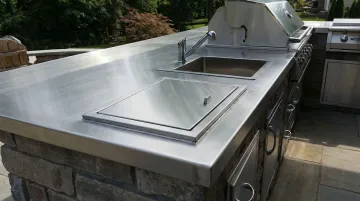
For high-end or non-standard outdoor kitchen layouts, custom fabrication delivers the most precise fit. Custom metal fabrication specialists offer fully tailored countertops with exact dimensions, custom cutouts for built-in grills and sinks, and your choice of 304 or 316 grade.
Why custom matters: Off-the-shelf countertops rarely accommodate non-standard island dimensions or multiple appliance cutouts. Custom fabrication ensures seamless integration with your outdoor kitchen design, including edge profiles optimized for water drainage.
What you get:
- Specified steel grade (304 for inland, 316 for coastal)
- Gauge selection (typically 14-16 gauge for heavy-duty outdoor use)
- Custom cutouts for grills, sinks, burners, and access panels
- Edge profile options (squared, radius, or marine edge)
- Brushed or commercial finish
| Specification | Details |
|---|---|
| Grade Options | 304 or 316 stainless steel, specified at order |
| Gauge Thickness | Typically 14–16 gauge for heavy-duty outdoor use |
| Price Range | $150–$250+ per linear foot (varies by gauge, grade, and complexity) |
For a countertop built to your exact specifications, contact a custom metal fabrication specialist at +1 888-501-3147.
Premium Option: Hestan Outdoor Living Suites
Hestan doesn't sell standalone stainless countertops. Instead, they offer fully integrated 8-foot and 12-foot Outdoor Living Suites featuring 1-piece welded stainless steel countertops built into heavy-gauge welded body chassis.
Key differentiators:
- Fully welded construction eliminates seams and weak points
- Professional-grade steel specification throughout
- Integrated design ensures appliance compatibility
- Complete outdoor kitchen solution (not just a countertop)
Hestan targets the ultra-premium market. If you want their countertop, you're buying the entire suite.
| Specification | Details |
|---|---|
| Grade/Material | Professional-grade stainless steel (grade not publicly specified) |
| Gauge/Thickness | Heavy-gauge welded construction |
| Price Range | $9,899–$11,999+ (8-foot to 12-foot suites, historical pricing) |
Mid-Range Option: Blaze Stainless Steel Island
Blaze Outdoor Products offers a 72-inch modular "Stainless Steel BBQ Island" (BLZ-SS-ISLAND) constructed entirely of 304 stainless steel. This ready-made solution eliminates custom fabrication lead times while delivering rust-resistant durability.
Best for: Mid-size outdoor kitchens with standard dimensions where modular sizing works.
Key differentiators:
- 304-grade stainless steel throughout (countertop and cabinetry)
- Modular design accelerates installation
- Lifetime warranty on stainless steel components
- Strong value at roughly $38 per inch — competitive for a fully warranted 304-grade island
| Specification | Details |
|---|---|
| Grade/Material | 304 stainless steel |
| Gauge/Thickness | Not publicly specified; likely 18-gauge |
| Price Range | $2,754 (72-inch island) |
Best for Coastal Climates: 316 Marine-Grade Custom Countertops
Standard 304 stainless steel is vulnerable to pitting and crevice corrosion in chloride-rich environments. If you're within 10 miles of the coast or near saltwater pools, 316-grade is the correct choice.
The metallurgical difference: 316-grade adds 2–3% molybdenum to the alloy, significantly improving chloride resistance. Industry guidelines generally recommend Type 316 for installations within 3,000 feet of the ocean.
Trade-offs: 316-grade costs approximately 37% more than 304-grade in raw materials. Ready-made options are rare — most 316 countertops are sourced through specialty fabricators like Stainless Supply.
| Specification | Details |
|---|---|
| Grade/Material | 316 marine-grade stainless steel |
| Gauge/Thickness | 14–16 gauge (custom specified) |
| Price Range | $200–$300+ per linear foot (37% premium over 304-grade) |
Budget-Friendly Option: NewAge Products 304 Stainless Countertops
For smaller outdoor kitchens or DIY builds, NewAge Products offers dedicated outdoor stainless steel countertops crafted from 304-grade steel with an integrated easy-mount system and 10-year warranty.
Best for: Budget-conscious homeowners with standard-size outdoor kitchen islands.
Trade-offs:
- Thinner gauge than professional-grade custom options
- Limited size options (56-inch to 96-inch)
- No custom cutouts for appliances (DIY installation required)
When to invest more: If your outdoor kitchen sees heavy daily use, upgrade to 16-gauge custom fabrication. Thinner gauges dent more easily under heavy pots and thermal stress.
| Specification | Details |
|---|---|
| Grade/Material | 304 stainless steel |
| Gauge/Thickness | Not specified; likely 18-gauge |
| Price Range | $539 (56-inch) to $1,099 (96-inch) |
⚠️ Avoid 430-grade budget traps: Cheap restaurant-supply work tables often use 430-grade stainless steel, which lacks the nickel content needed for outdoor corrosion resistance. Always verify 304-grade before purchasing.
What to Look for in an Outdoor Stainless Steel Countertop
Not all stainless steel countertops hold up equally outdoors. Five factors — grade, gauge, finish, edge profile, and underlayment — determine whether your countertop lasts a decade or starts pitting within two years.
Steel Grade: 304 vs. 316
The practical difference comes down to chromium, nickel, and molybdenum content:
- 304 stainless steel: 18–20% chromium, 8–10.5% nickel, 0% molybdenum. Sufficient for most inland climates.
- 316 stainless steel: 16–18% chromium, 10–14% nickel, 2–3% molybdenum. Required for coastal or high-humidity zones. Use 316-grade if you're within 5–10 miles of saltwater — FEMA recommends it within 3,000 feet of the ocean.
Gauge Thickness: Lower Number = Thicker Steel
Gauge number works inversely—lower gauge means thicker, more durable steel.
| Gauge | Thickness | Application |
|---|---|---|
| 14-gauge | 0.0781 inches | Commercial kitchens; heavy-duty outdoor use with integrated sinks |
| 16-gauge | 0.0625 inches | Standard recommendation for outdoor countertops; resists denting |
| 18-gauge | 0.0500 inches | Light-use areas; more prone to warping and impact damage |
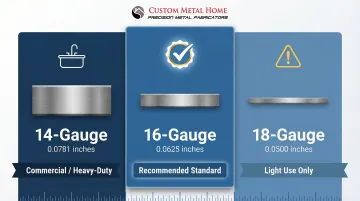
Specify 16-gauge minimum for outdoor countertops. If you're installing heavy integrated sinks or expect commercial-level use, step up to 14-gauge.
Finish Type: Brushed, Polished, or Powder-Coated
- Brushed (#4 finish): Directional grain hides scratches and fingerprints; most popular for outdoor countertops — and the right choice for most installations
- Polished (#8 mirror finish): Highlights every smudge and scratch; impractical for high-traffic prep areas
- Powder-coated: Matte, UV-resistant, available in colors; used for cabinetry, not horizontal worktops
Fabrication Fit and Edge Profiles
Countertops with pre-cut holes for grills, sinks, or burners require precise measurements. Edge profiles affect both safety and water drainage:
- Squared edge: Clean, modern look; no raised lip
- Radius edge: Rounded corners for safety
- Marine edge: Raised V-edge (1/8 to 1/2 inch) prevents water and grease from running off the surface — specify this for any outdoor kitchen exposed to rain or regular hosing down
Underlayment and Support
Stainless steel countertops must be supported by a solid substrate. Standard indoor materials like MDF absorb moisture, swell, and warp the steel above.
Outdoor-rated substrates:
- Marine-grade plywood (MDO): Manufactured with waterproof resins for outdoor and marine applications
- Stainless steel hat channels: Galvanized or stainless structural channels eliminate wood entirely
Skipping proper substrate in a climate with wide temperature swings or high humidity will warp the countertop — often within the first few seasons.
How We Chose the Best Stainless Steel Countertops
We evaluated options based on:
- Steel grade (304 vs. 316)
- Gauge thickness (14, 16, or 18 gauge)
- Finish durability (brushed, polished, powder-coated)
- Customization flexibility (standard sizes vs. custom fabrication)
- Coastal/weather suitability
- Verified user and industry reviews
Common buyer mistakes:
- Prioritizing aesthetics over grade specification
- Choosing 18-gauge steel to save cost (then replacing it in 5 years due to denting)
- Using 430-grade restaurant tables for permanent outdoor installation
- Skipping 316-grade in coastal areas
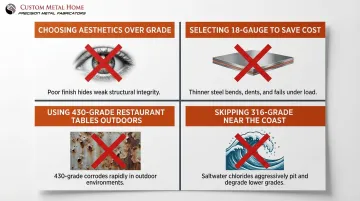
No single product is "best" for all buyers. The right choice depends on your climate zone, kitchen size, budget, and whether you're going modular or building a fully custom island.
Conclusion
Stainless steel is the most practical and durable choice for outdoor kitchen countertops in 2025—but your choice of grade, gauge, and finish directly affects how long it lasts and how much upkeep it demands.
Assess your climate first. If you're within 10 miles of the coast, specify 316-grade. For inland installations, 304-grade delivers excellent durability at a lower cost. Prioritize 16-gauge thickness minimum, and choose a brushed finish to minimize visible scratches and fingerprints.
Custom fabrication ensures the precise fit that prefabricated options often cannot deliver, especially for non-standard dimensions or multiple appliance cutouts. If you want a countertop built exactly to your outdoor kitchen's specifications, call +1 888-501-3147 to discuss custom stainless steel options tailored to your project.
Frequently Asked Questions
What is the best stainless steel for an outdoor kitchen?
Grade 304 stainless steel is the standard recommendation for most outdoor kitchens due to its corrosion resistance and durability. Grade 316 (marine-grade) is recommended for coastal or high-humidity environments because of its added molybdenum content that resists salt-air corrosion.
What is the most durable countertop for an outdoor kitchen?
Stainless steel is widely considered the most durable countertop material for outdoor kitchens because it is non-porous, heat-resistant, and requires no sealing—unlike granite or concrete, which can crack, stain, or absorb moisture over time.
How thick should stainless steel countertops be for outdoor use?
16-gauge (approximately 1/16 inch thick) is the recommended minimum for outdoor kitchen countertops to resist denting from heavy use. 14-gauge is preferred for commercial-grade durability, while 18-gauge may be used for light-use areas but is more prone to warping and impact damage.
Do stainless steel countertops rust outdoors?
High-quality 304 or 316 stainless steel countertops are highly rust-resistant due to their chromium oxide layer. However, lower-grade alloys (430, 201) can corrode in humid or coastal environments. Choosing the right grade from the start — and keeping the surface clean — is your most effective protection.
How do you maintain stainless steel countertops in an outdoor kitchen?
Wipe down regularly with mild soap and water, cleaning in the direction of the grain to avoid micro-scratches. Treat occasionally with a stainless steel protectant. Cover or enclose the countertop during long periods of non-use to protect the surface and extend its life.
Are custom stainless steel countertops worth it for outdoor kitchens?
Custom fabrication is worth the investment for built-in outdoor kitchens with non-standard dimensions, multiple appliance cutouts, or specific aesthetic requirements. It eliminates the fitting issues common with prefabricated sections and lets you specify the exact grade and gauge you need.